
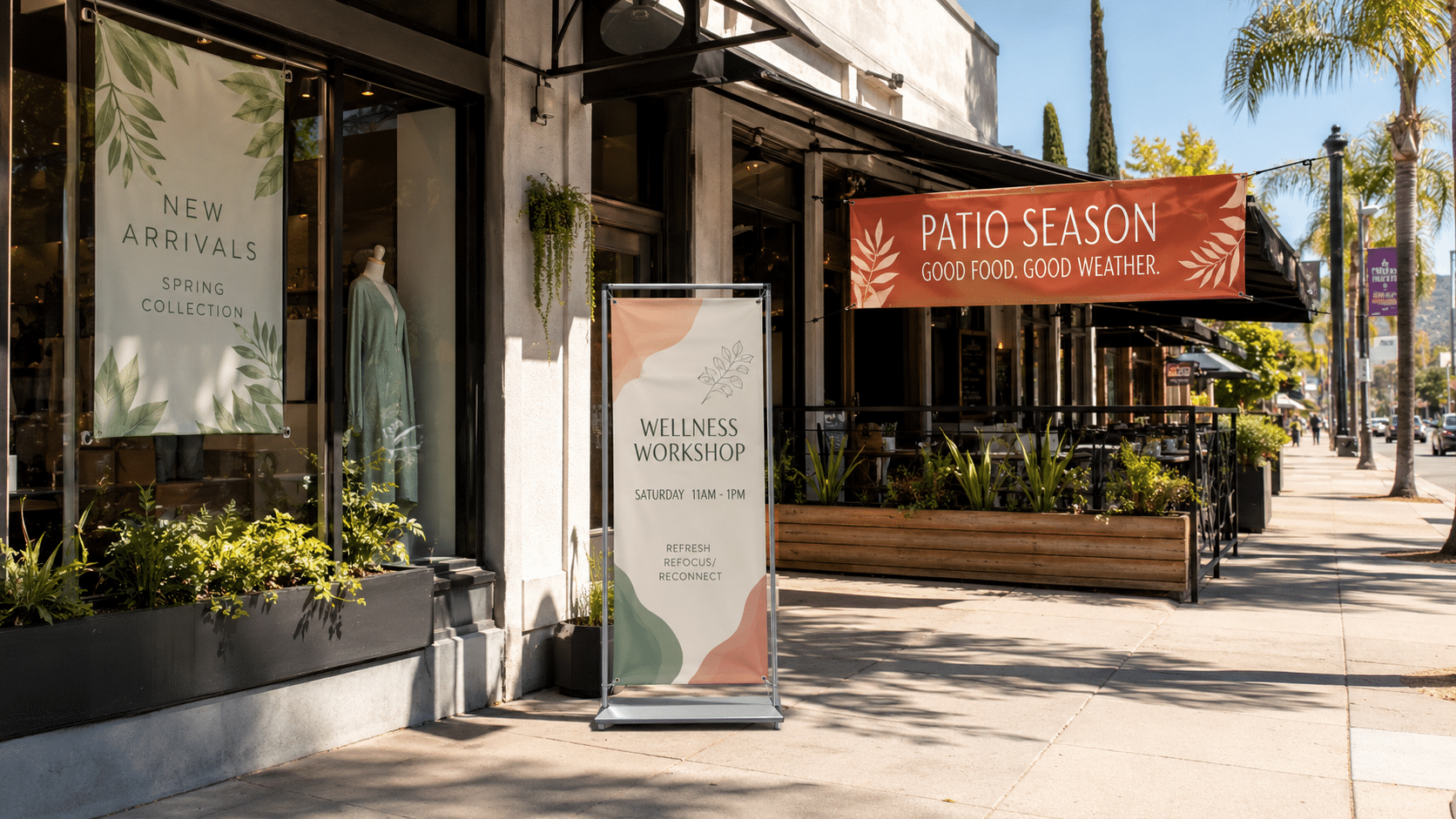
Custom vinyl banners are the most flexible product in commercial signage and the most underestimated. They go up in an afternoon, cost a fraction of permanent signage, and can be replaced entirely when a message changes. For Los Angeles businesses managing openings, promotions, events, and construction timelines, that flexibility solves problems a permanent sign cannot, which is why banners frequently appear alongside custom sign services rather than instead of them.
SHORT ANSWER
Banners work best for anything temporary, seasonal, or changing: openings, promotions, events, construction sites, hiring, and bridging the gap while a permanent sign is fabricated. Choose standard weight vinyl for most applications, heavier vinyl for extended outdoor use, and mesh anywhere wind is a factor. Check local rules before hanging one, since many jurisdictions permit temporary banners only for a limited period.
10 Ways Los Angeles Businesses Use Custom Vinyl Banners
1. Grand openings and now open announcements
A new business needs visibility immediately, and permanent signage takes time to design, permit, fabricate, and install. A banner captures traffic from day one.
2. Bridging the wait for permanent signage
This is the most practical use and the one most owners do not think of. Between lease signing and a finished storefront sign, a business can operate for weeks without identification. A banner covers that gap and comes down when the permanent storefront signage goes up.
3. Sales, promotions, and seasonal campaigns
Limited-time messaging needs to change often, which makes permanent signage the wrong medium. Banners let a retailer run different messages through the year without touching the primary sign.
4. Construction sites and development fencing
Developers use banners on perimeter fencing to identify the project, credit contractors, and advertise leasing. Mesh material is standard here, since solid vinyl on a long fence run acts as a sail.
5. Trade shows and convention displays
Booth backdrops, hanging banners, and step and repeat walls travel easily, install without tools, and can be reprinted for each show as branding evolves.
6. Event and sponsor recognition
Tournaments, fundraisers, and community events use banners to display sponsor logos at scale. The same principle applies at athletic facilities, where temporary graphics can cover or supplement permanent sponsor displays around scoreboards for a specific event.
7. Real estate leasing and space available
Commercial brokers rely on banners for vacant retail and office space, where a large, readable message on the building outperforms a yard sign at the curb.
8. Hiring and recruitment
A now hiring banner on a building reaches people already in the neighborhood, which for restaurants, retail, and warehouse operations is exactly the labor pool they want.
9. Film and production location signage
Los Angeles has a use most cities do not. Productions need directional signage, base camp identification, and location markers that install fast, survive a shoot, and disappear afterward. Banners and printed graphics fill that role constantly across the region.
10. Building wraps and large-format displays
At the largest scale, printed vinyl covers building facades and scaffolding for advertising or to screen work in progress. These installations carry their own regulatory requirements and are not simply oversized banners.
Choosing the Right Material
Material selection is where banner quality is decided, and it comes down to three questions: indoor or outdoor, how long it needs to last, and how much wind it will see.
Standard weight vinyl handles most indoor and outdoor promotional work, offering strong color reproduction at a reasonable cost.
Heavier weight vinyl suits longer outdoor exposure and installations that stay up for months rather than weeks.
Mesh vinyl is perforated so air passes through, which is the correct choice for fences, building faces, and any exposed location. A solid banner in a windy spot tears itself off its grommets or takes the fence with it.
Fabric suits indoor displays where a softer finish reads better than vinyl’s sheen.
Los Angeles sun is the other variable. Sustained ultraviolet exposure fades printed graphics, and inks formulated for outdoor use hold color considerably longer. A banner intended to last a season should be specified differently than one hanging for a weekend.
Finishing and Installation Details
Finishing determines whether a banner survives its intended life.
- Hemming. Folded and welded edges prevent tearing at the perimeter, which is where failure starts.
- Grommets. Reinforced eyelets spaced appropriately for the size. Too few grommets concentrates load and tears the material.
- Pole pockets. Sewn channels at top and bottom for banners hung on poles or rods rather than tied through grommets.
- Reinforced corners. Worth specifying on larger outdoor banners, since corners take the most stress.
- Wind slits. Frequently requested and rarely the right answer. Mesh material handles wind better without cutting holes in the artwork.
Mounting matters as much as the banner. Bungee cords allow movement that reduces stress at grommets, while zip ties pulled tight create rigid attachment points that tear. On masonry, mounting hardware should be appropriate to the substrate rather than improvised.
The Permit Question Nobody Asks Until Later
Temporary signage is regulated, and this catches business owners regularly.
Many jurisdictions across Los Angeles County allow banners under a temporary sign permit valid for a defined period, with limits on size, quantity, and how often permits may be issued to the same business. The common failure is not the initial installation. It is leaving the banner up past expiration, at which point a permitted sign becomes a code violation.
Rules differ substantially between the City of Los Angeles and the independent cities around it, and stricter standards often apply in specific plan areas, design overlays, and historic districts. Confirming the requirements through sign permitting support before hanging a banner takes far less effort than responding to an enforcement notice.
When a Banner Is the Wrong Tool
Banners solve temporary problems. Used for permanent ones, they cost more over time and work against the business.
A banner serving as primary identification for a year signals impermanence to customers, whatever the quality of the business behind it. It also accumulates replacement costs while a permanent sign would have been a single investment, and it may exceed what local rules allow for temporary signage. If the message is not changing and the need is ongoing, the banner has become a placeholder for a decision rather than a solution.
Key Takeaways
- Banners suit temporary, seasonal, and changing messages rather than permanent identification.
- Bridging the gap while permanent signage is fabricated is among their most practical uses.
- Mesh material is the correct choice anywhere wind is a factor, not wind slits in solid vinyl.
- Hemming, adequate grommets, and reinforced corners determine how long a banner lasts.
- Los Angeles sun fades graphics, so specify outdoor-rated printing for anything staying up more than briefly.
- Temporary banner permits typically carry duration limits, and leaving a banner up past expiration creates a violation.
- A banner used as permanent signage costs more over time and reads as temporary to customers.
Frequently Asked Questions
How long does a vinyl banner last outdoors?
It depends on material weight, ink, exposure, and wind. A standard banner handles a promotional period comfortably, while extended outdoor display calls for heavier material and outdoor-rated inks. Direct sun and wind both shorten service life.
Do I need a permit to hang a banner on my building?
Frequently yes, under a temporary sign permit with a defined duration. Requirements vary by jurisdiction, so confirm with the department covering your address before installing.
What size banner should I order?
Size follows viewing distance and available mounting area. A banner read from across a parking lot needs larger lettering than one read from the sidewalk. Local rules may also cap temporary sign area.
Can a banner be reused?
Yes, if it is stored properly. Roll rather than fold, since creases in vinyl are permanent and show in the artwork. Clean and dry before storing.
Why did my last banner tear at the corners?
Usually insufficient grommets, missing hemming, or rigid mounting that gave the material nowhere to move. Wind exposure without mesh material produces the same result.
Is mesh worth the extra cost?
Anywhere wind is present, yes. A solid banner on a fence or exposed wall transfers wind load to its attachment points, and the failure damages the banner, the mounting, or both.
Conclusion
Custom vinyl banners earn their place in Los Angeles commercial signage by handling everything permanent signs cannot: short timelines, changing messages, and locations that will not exist next month. Specifying the right material and finishing for the application, and confirming what local rules allow before hanging it, is most of what separates a banner that works from one that fails in the first windy week.
Los Angeles Sign Company produces banners, storefront signage, architectural signage, and custom fabrication for businesses across Los Angeles, Orange County, Ventura County, Riverside County, and San Bernardino County. Whether you need a banner for an opening next week or a permanent sign to replace one, reach out today for a free consultation.
