
Digital signage covers any display that shows content electronically rather than printing it once and leaving it there. That definition sounds broad because it is, spanning a menu board above a counter, a lobby directory, a scoreboard at a field, and an electronic message display facing a boulevard. What connects them is that the message can change without anyone replacing a sign face. For Los Angeles businesses the appeal is obvious, and the constraint is one most people discover late: in this region, whether you can install one is usually decided by sign permitting rather than by the technology or the budget.
SHORT ANSWER
Digital signage is an electronic display, typically LED or LCD, showing content that can be updated remotely or on a schedule. Common formats include indoor displays, digital menu boards, lobby directories, video walls, scoreboards, and outdoor electronic message displays. The advantages are changeable content, scheduled messaging, and multiple messages on one sign. The main constraint in Los Angeles is regulatory, since electronic displays are among the most heavily restricted sign types and rules vary sharply between the City of Los Angeles and the independent cities around it.
What Digital Signage Actually Is
Two components make up any installation: the display and the system that feeds it content.
Indoor displays are generally LCD panels, often commercial-grade units built for extended operating hours rather than consumer televisions. Outdoor displays are typically direct-view LED, because they need brightness levels that LCD cannot reach in daylight, along with weather sealing and heat management. That second requirement matters more here than in most markets, since a display in direct Southern California sun is managing both ambient heat and its own.
Content is handled either by a standalone player loaded locally or by a networked content management system, usually cloud-based, that lets one person update every screen across multiple locations and schedule what appears when. Networked systems cost more to run and are the reason most multi-location operators choose digital in the first place.
The Formats LA Businesses Actually Use
- Digital menu boards. Restaurants and quick service operators, where prices and items change and where the board can switch automatically between breakfast, lunch, and dinner.
- Indoor promotional displays. Retail floors, showrooms, and service counters running product content and offers.
- Lobby directories and wayfinding. Multi-tenant office buildings and medical facilities, where a tenant change is a content edit rather than a fabrication job.
- Video walls. Multiple panels driven as one surface, used in lobbies, showrooms, and entertainment venues for impact.
- Interactive touchscreens. Wayfinding, product lookup, and check-in.
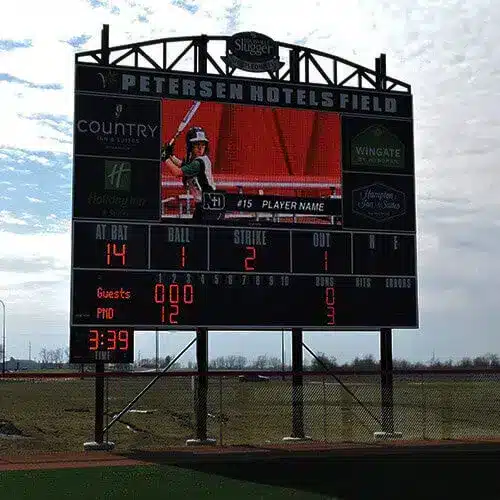
- Scoreboards and venue displays. Schools, parks, and athletic facilities, which is its own category of digital scoreboard work with different mounting, control, and durability requirements.
- Outdoor electronic message displays. The category facing the street, and by a wide margin the most regulated.
Why Businesses Choose It
The practical case is straightforward.
Content changes without fabrication. Updating a printed menu board or a static sign panel means producing and installing new material. Updating a digital one takes minutes.
Scheduling. A display can run different content by time of day, day of week, or season without anyone touching it.
More than one message. A static sign says one thing. A digital display cycles through several, which is why operators with multiple services or a changing inventory tend toward it.
Remote management. For a business with several locations, one person updating every screen from one place is a genuine operational saving.
The honest counterweight is cost structure. Digital signage carries a higher upfront investment, ongoing costs for content management and power, and a service life that ends in replacement rather than repainting. It earns its place where content genuinely changes, and it does not where the message is fixed.
The Los Angeles Regulatory Reality
This section is the one worth reading before pricing hardware.
Electronic displays are among the most tightly controlled sign types in this region, and the rules are not uniform. The City of Los Angeles regulates signage closely, with additional requirements layered on through specific plan areas, sign districts, community design overlays, and historic preservation zones. The independent cities across the county, including Beverly Hills, Culver City, Santa Monica, Pasadena, Glendale, Burbank, and West Hollywood, each administer their own ordinances, and some restrict or prohibit electronic message displays far more aggressively than others.
Where electronic displays are permitted at all, the conditions commonly address brightness limits and automatic dimming after dark, how frequently the message may change and how long each message must hold, whether motion or animation is allowed, and where on the property or building the display may sit.
There is also a distinction that catches people out. On-site signage advertising the business at that location is regulated differently from off-site advertising, and new off-site displays face substantially greater restriction.
The practical sequence is to confirm what your specific address allows before selecting equipment. A display that is legal in one city and not in the next one over is a common and expensive discovery, and it is the reason permitting should lead the project rather than follow it.
Specification Details That Matter Here
- Brightness and dimming. Outdoor displays need enough output to read in daylight and the ability to dim automatically at night, which is frequently a permit condition rather than a preference.
- Pixel pitch. The spacing between LEDs determines how close a viewer can stand before the image breaks up. Longer viewing distances tolerate coarser pitch at lower cost.
- Weather and heat. Outdoor enclosures need sealing and thermal management, and sustained Southern California sun is a real load on both.
- Power and data. Displays need dedicated circuits and network connectivity, and retrofitting either into an existing storefront adds scope.
- Structure and mounting. Displays are heavier than the static signage they replace, and freestanding installations bring foundation and structural review into the project.
- Serviceability. Plan access for module and power supply replacement before installation, not after something fails twenty feet up.
When Static Signage Is Still the Better Answer
Digital is not an upgrade in every case, and treating it that way wastes money.
Primary building identification, the sign carrying your name, generally works better as permanent fabricated signage. It is what people navigate to, it does not need to change, and it reads as established in a way a screen does not. Channel letters, dimensional lettering, and illuminated storefront signage remain the right tool for that job.
The strongest programs usually combine both: permanent identification establishing the brand, with digital handling the content that genuinely changes. Deciding which element does which is the useful conversation, and it is better had during sign design than after one has already been ordered.
Key Takeaways
- Digital signage is an electronic display plus a system for managing what appears on it.
- Outdoor installations generally use direct-view LED for daylight brightness; indoor uses commercial LCD.
- The operational advantages are changeable content, scheduling, multiple messages, and remote management.
- Ongoing costs include content management, power, and eventual replacement rather than refinishing.
- Electronic displays are among the most heavily restricted sign types across Los Angeles County.
- Rules differ sharply between the City of Los Angeles and surrounding independent cities.
- Brightness, dimming, message hold time, and motion are common permit conditions.
- Permanent identification is usually still better served by fabricated static signage.
Frequently Asked Questions
Can any business in Los Angeles install a digital sign?
No. Whether an electronic display is permitted depends on the jurisdiction, the zoning, and any overlay or specific plan applying to the address. Some cities restrict them severely and some prohibit certain types outright. Confirm before selecting equipment.
Can I use a regular television for digital signage?
For low-hour indoor use it sometimes works, but consumer televisions are not built for continuous operation, sustained brightness, or portrait orientation. Commercial displays are rated for extended duty and generally last longer in this application.
What does pixel pitch mean?
The distance between individual LEDs on the display. Tighter pitch gives a sharper image at close range and costs more. A sign read from across a parking lot does not need the pitch a lobby display does.
How long do digital displays last?
Service life depends on the product, hours of operation, brightness levels, and environment. Outdoor units in full Southern California sun work harder than indoor ones. Power supplies and individual modules are typically serviceable before whole-unit replacement.
Do digital signs need their own permit?
Generally yes, and often with additional review beyond a standard sign permit because of brightness, illumination type, and motion. Converting an existing static sign to digital is usually treated as an alteration rather than maintenance.
Is digital cheaper than replacing static signs over time?
It can be where content changes frequently, since each static update means fabrication and installation. Where the message is fixed, a permanent sign is almost always the better value.
Conclusion
Digital signage is worth considering wherever your message genuinely changes, and worth skipping where it does not. The technology question is the easy part. The part that determines whether a project is feasible is what your specific address permits, and in Los Angeles County that answer varies street by street rather than region-wide.
Los Angeles Sign Company designs, permits, fabricates, and installs business signage across Los Angeles, Orange County, Ventura County, Riverside County, and San Bernardino County, and handles ongoing service and maintenance once signage is in place. If you are weighing digital against permanent signage for your location, reach out today for a free consultation.
