
Getting a sign made is the part most business owners think about. Getting it installed correctly is the part that actually determines whether it lasts, stays legal, and looks the way it should on opening day.
Commercial sign installation in Los Angeles is a multi-stage technical process. It involves structural engineering, city permitting, electrical work, and careful coordination between trades. Miss any one of those steps and you are looking at code violations, costly rework, or a sign that fails within the first year. This guide walks through the full process so you know exactly what to expect before a single bolt goes into a wall.
Why Los Angeles Sign Installation Is More Complex Than Most Cities
Los Angeles has some of the strictest and most layered municipal sign codes in the country. The city’s Department of Building and Safety, along with individual neighborhood overlay districts, Historic Preservation Overlay Zones, and Business Improvement Districts, each carry their own set of rules about what can be installed, where, at what height, and with what type of illumination.
A sign that is perfectly legal in Burbank may violate signage regulations in West Hollywood. A monument sign that works in a Pasadena strip mall may require a variance in Beverly Hills. This patchwork of local regulations is one reason why installation in LA cannot be treated as a simple bolt-and-go job. Every project requires upfront research before anything physical happens on site. Understanding what professional signage installations involve from the start helps set realistic expectations for the entire process.
Stage One: The Site Survey
Before any designs are finalised or materials ordered, a proper installation starts with a site survey. This is the diagnostic phase, and skipping it is one of the most common mistakes independent operators make.
A site survey typically covers:
- Wall or substrate material: Brick, stucco, concrete, glass, metal cladding, and wood each require different anchoring methods and hardware.
- Electrical access points: Where are the nearest power sources? Is there conduit already running to the sign location, or does new wiring need to be routed?
- Structural integrity: Can the wall or support structure bear the load of the proposed sign? Larger channel letter sets and cabinet signs can weigh several hundred pounds.
- Sight lines and visibility: At what angle will pedestrians and drivers see the sign? Height, projection, and letter size all affect readability from the street.
- Permit restrictions for that specific address: Zoning, overlay zones, and landlord restrictions are all reviewed at this stage.
The survey output feeds directly into the engineering drawings and permit application. Without accurate site data, those documents cannot be completed correctly, which delays every subsequent phase.
Stage Two: Engineering Drawings and Permit Applications
Once site data is collected, structural engineers produce the calculations and drawings required by the city. These documents specify the mounting hardware, load capacity, wind resistance ratings, and electrical specifications for the sign.
Los Angeles requires permitted sign installations to be stamped by a licensed engineer for anything beyond a small flat panel. Channel letters, monument signs, pylon signs, and high-rise signage all fall into this category.
The permit application itself is submitted to the Los Angeles Department of Building and Safety, or to the relevant municipality if the project is in a city like Santa Monica, Culver City, or Pasadena, each of which has its own permitting authority. Processing times vary widely. Standard review can take several weeks, while more complex projects involving electrical permits or variance requests can take considerably longer.
Full-service sign companies handle this entire stage in-house, preparing the drawings, submitting the application, and tracking approvals so the client does not have to navigate the bureaucracy themselves. It is genuinely one of the more valuable things a seasoned sign company brings to the table in this market.
Stage Three: Structural Mounting
This is the visible, physical part of installation, but it requires just as much precision as the paperwork that comes before it.
Anchor Selection and Wall Type
The anchoring method depends on the wall substrate identified during the site survey. Common approaches include:
- Concrete and masonry walls: Expansion anchors or sleeve anchors set with hammer drills. For heavier signs, through-bolts may be required with backing plates on the interior wall.
- Metal stud framing with stucco or drywall cladding: Toggle bolts or structural blocking installed inside the wall cavity before the cladding is finished.
- Steel building facades: Welded or bolted mounting brackets fabricated to match the sign’s frame dimensions.
- Glass storefronts: Standoff hardware using adhesive anchors or drilled glass fittings, though weight limits here are much lower.
Getting the anchor type wrong does not just risk the sign falling. It can cause water infiltration, wall damage, and structural liability for the property owner.
Leveling, Alignment, and Spacing
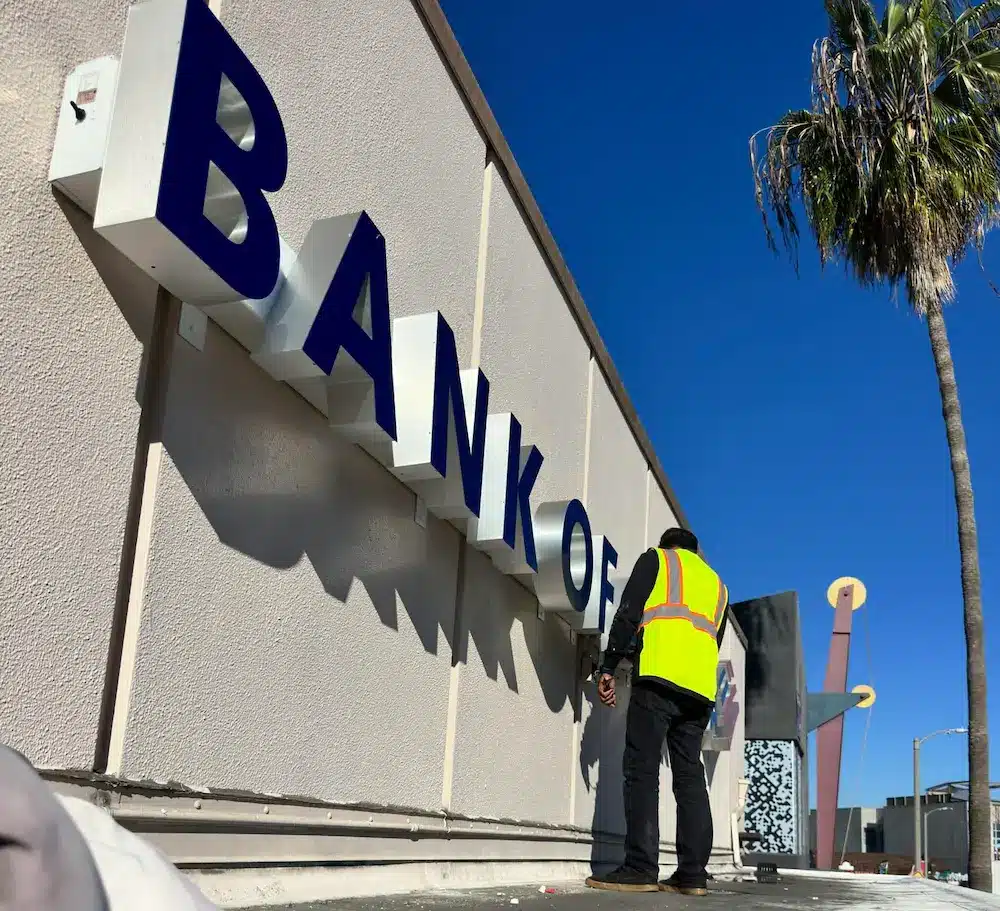
Channel letter sets require individual placement of each character. Installers use layout templates, laser levels, and string lines to ensure consistent spacing and perfect horizontal alignment across the full sign run. A sign that looks slightly uneven from 50 feet away was almost certainly rushed through this phase.
Cabinet signs and monument bases are set using surveying equipment when precise grade-level placement is required. The base may need to be anchored into a concrete footing that was poured separately in advance.
Stage Four: Electrical Connections
Illuminated signs, which represent the majority of commercial signage installations in Los Angeles, require electrical work that must be completed by a licensed electrician and inspected before the sign is energised.
What the Electrical Phase Involves
- Conduit routing: Weatherproof conduit carries the wiring from the power source to the sign housing. Routing it cleanly and discreetly is both a code requirement and an aesthetic consideration.
- Transformer installation: LED and neon signs use transformers or power supplies sized specifically for the sign’s draw. These are housed inside the sign cabinet or within an accessible junction box.
- Grounding: All metal sign structures must be properly grounded to prevent shock hazard and comply with the National Electrical Code, which California has adopted with state-specific amendments.
- Inspection: The final electrical connection cannot be energised until a city inspector has signed off on the work.
For signs using LED illumination, which now accounts for the vast majority of new commercial signage given the energy efficiency gains over neon or fluorescent, the power supply specifications need to match the LED module ratings exactly. A mismatched driver is one of the most common causes of premature LED failure.
The Coordination Challenge in LA
Large signage installations in Los Angeles regularly involve multiple trades working on overlapping timelines. Electricians, structural installers, and crane or lift operators may all need to be scheduled around city inspection windows, tenant move-in dates, and building access restrictions.
Properties in Downtown LA, Hollywood, and Beverly Hills often have strict rules about when installation crews can access loading areas or use street-facing scaffolding. Special event restrictions, filming permits in certain neighborhoods, and HOA guidelines can all affect scheduling.
This coordination layer is where experience makes a genuine difference. A company like Los Angeles Sign Company, which has spent over 20 years managing projects across the most complex jurisdictions in the region, understands how to sequence these phases to avoid costly delays.
Common Installation Problems and How to Avoid Them
Even well-planned projects encounter issues. Knowing the common failure points helps set realistic expectations.
- Permit delays caused by incomplete engineering documents: Ensure your sign company submits stamped drawings the first time. Resubmissions can add months to a timeline.
- Incorrect anchor depth in older buildings: Older commercial buildings in areas like Koreatown or Silver Lake may have walls that do not match their apparent construction. A thorough survey catches this before installation day.
- Water infiltration at penetration points: Every hole drilled for an anchor or conduit needs to be sealed with an appropriate weatherproof compound. Neglecting this step leads to interior wall damage over time.
- Electrical load miscalculations: Adding a large illuminated sign to an older retail space may require a panel upgrade. This is worth checking before the installation date, not on it.
Key Takeaways
- A proper site survey is the foundation of every successful commercial sign installation. It drives the engineering, permitting, and mounting decisions that follow.
- Los Angeles permitting is genuinely complex. Projects spanning different cities or overlay zones require separate applications and different review processes.
- Anchor selection must match the specific wall substrate. Using the wrong hardware creates structural and weatherproofing risks.
- Electrical work on illuminated signs requires a licensed electrician, correct transformer specifications, and a city inspection before energising.
- Scheduling and trade coordination in LA requires experience with local access restrictions, inspection timelines, and jurisdiction-specific requirements.
Frequently Asked Questions
How long does commercial sign installation take in Los Angeles? The physical installation of most commercial signs takes one to three days depending on complexity. The full timeline from initial site survey to completed installation, including permitting, typically runs six to twelve weeks for standard projects and longer for complex or high-rise installations.
Do I need a permit for every sign in LA? Most permanent exterior signs in Los Angeles require a permit. Temporary signs, window graphics, and some interior signage may be exempt, but the rules vary by zone and sign type. Checking with the city or working with a sign company that handles permitting directly is the safest approach.
What happens if a sign is installed without a permit? Unpermitted signs can result in stop-work orders, fines, and mandatory removal at the property owner’s expense. In some cases, the city can issue a notice of violation that affects the property record and complicates future permits.
Can any building wall support a large illuminated sign? Not always. Older buildings, glass facades, and lightweight steel-stud construction have load limits that may not accommodate heavy cabinet signs or large channel letter sets without structural reinforcement. This is exactly what the engineering phase is designed to determine.
What is the difference between a pylon sign and a monument sign? A pylon sign is elevated on a single or double pole structure, typically positioned for visibility from a distance or at road speed. A monument sign sits at or near ground level on a solid base, usually used at property entrances. Both require permits, engineering drawings, and in many cases, a concrete footing installation.
Conclusion
Commercial sign installation is more involved than most people realise until they are in the middle of a project. The physical mounting is only one part of it. The survey, the engineering, the permits, the electrical work, and the coordination all have to come together in the right order or the timeline and the budget start to slip.
For anyone planning a new storefront, rebranding an existing location, or managing a commercial development in the Los Angeles area, understanding this process upfront makes everything easier.
When you are ready to move forward, get a quote from a team that handles every stage of the process, from the first site visit through the final inspection.
