
Walk down Broadway in Downtown LA on a clear evening, and you are surrounded by history. Not in museums or plaques, but hanging above storefronts in crackling tubes of argon and neon gas, painted porcelain, and hand-lettered sheet metal. Los Angeles has more surviving vintage commercial signage than almost any other American city. That is not an accident. It is the result of deliberate preservation effort, skilled restoration work, and a growing understanding of what these signs actually represent.
Restoring them, though, is nothing like painting a wall or swapping out a light fixture.
Why Historic Signage in LA Deserves More Attention Than It Gets
The National Trust for Historic Preservation has long recognised commercial signage as a legitimate form of cultural heritage. In Los Angeles, that recognition carries extra weight. The city’s built environment developed rapidly through the mid-twentieth century, and neon was the visual language of that era. Motels, theatres, diners, pharmacies, and dance halls all competed for attention with glowing tubes of coloured light.
Many of those signs are still up. Some are still working. Others have been dark for decades, waiting.
What makes LA unusual is the concentration of historic commercial corridors that remain largely intact: Broadway, Hollywood Boulevard, Lincoln Boulevard in Venice, Ventura Boulevard in the Valley. These strips contain signs from the 1930s through the 1980s, representing multiple generations of commercial typography and fabrication technique.
Losing them is not just a cultural loss. Research from urban planning circles consistently shows that historic commercial streetscapes attract foot traffic, support tourism, and increase surrounding property values. The signs are, in a very real sense, an economic asset.
The Three Main Types of Restoration Work
Not all historic sign restoration is the same. The approach depends heavily on the sign’s original construction, its current condition, and what the owner or preservation body wants to achieve.
1. Structural and Surface Restoration
Many vintage signs suffer from decades of deferred maintenance. Sheet metal rusts. Painted surfaces crack and peel. Mounting hardware corrodes or fails entirely. Before any cosmetic work begins, a structural assessment is essential.
This typically involves:
- Inspecting the frame, braces, and attachment points
- Testing for metal fatigue or weld failures
- Documenting the original paint layers (which can reveal the sign’s full history)
- Assessing whether the sign can be restored in place or needs to come down first
Signs on older masonry buildings require extra care. Drilling into historic brick without engineering guidance can cause structural damage that far outweighs the cost of the sign itself.
2. Neon Tube Repair and Replication
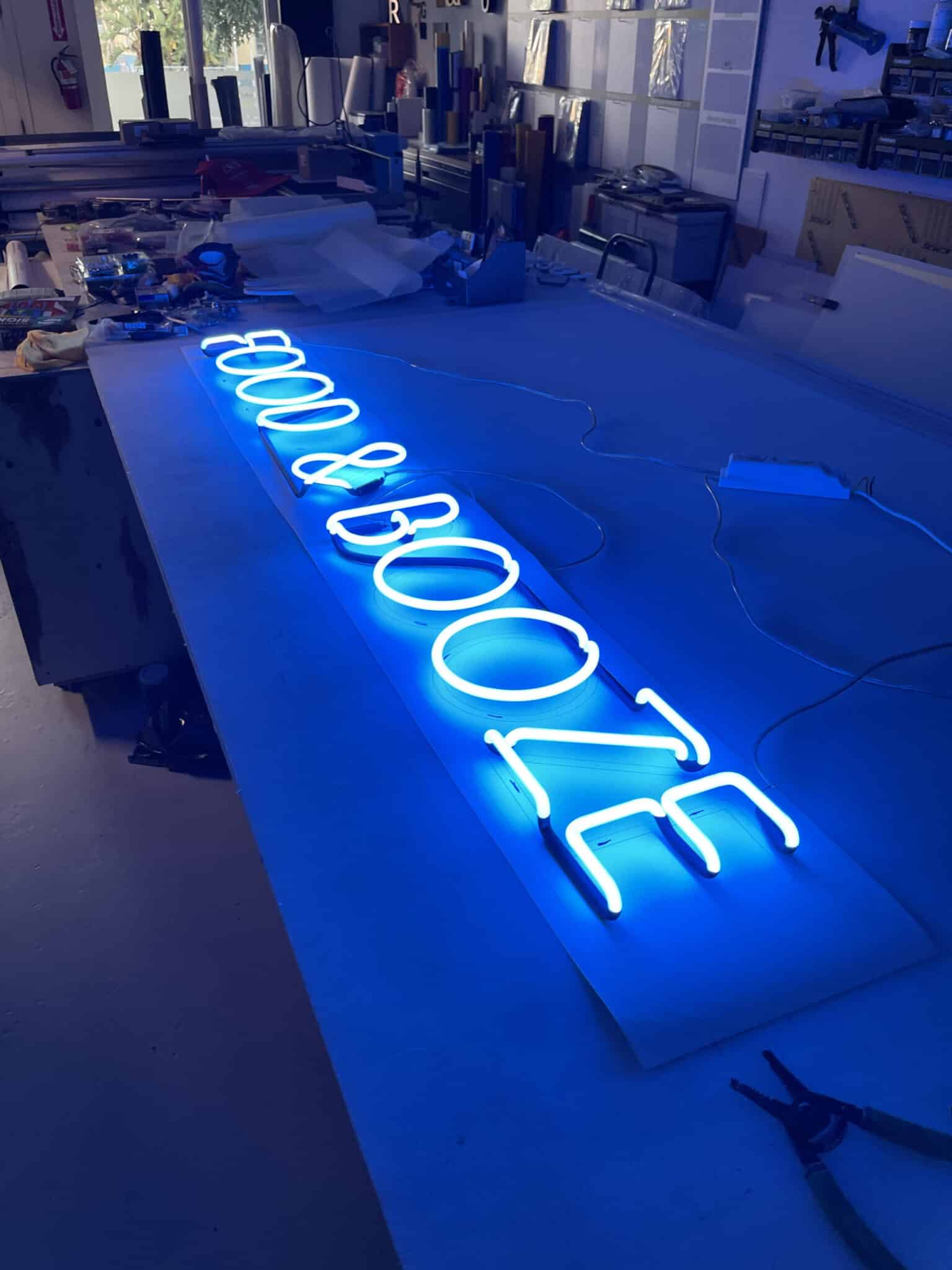
This is the most technically specialised part of the process. Neon signs use glass tubes bent into specific shapes and filled with noble gases, typically neon for red tones and argon with a mercury coating for blues and greens. The glass bending, gas filling, and electrode work all require a trained neon craftsperson.
Neon signs can last 10 to 15 years under normal conditions, but historic examples often have tubes that are 40, 50, or even 70 years old. Some sections can be re-gassed and reused. Others need to be remade from scratch, which requires matching the original colour temperature and tube diameter exactly.
Getting this wrong is immediately visible. A replacement tube that is slightly the wrong shade, or bent at a marginally different curve, can ruin the visual coherence of the entire sign. This is not a job for someone who does neon as a side line.
3. Electrical and Code Compliance Updates
Vintage signs were wired to electrical codes that no longer exist. Most historic neon signs use high-voltage transformers that predate modern safety standards. Restoring a sign for active use means bringing the electrical system up to current LA Department of Building and Safety requirements without destroying the sign’s historical character.
This often creates tension between preservation and compliance. A common solution is to retain the original external appearance while completely replacing the internal wiring and transformer. The sign looks as it always did. The system behind it meets today’s standards.
Hollywood: Where the Stakes Are Highest
Hollywood Boulevard has been the subject of ongoing preservation battles for decades. The walk-of-fame corridor contains some of the city’s most photographed vintage signage, including theatres, hotels, and entertainment venues that date back to the 1920s and 1930s.
Restoration work here is particularly scrutinised. The Hollywood Redevelopment Plan and various cultural heritage designations mean that any work touching a historically significant sign must be documented and, in many cases, approved before it begins.
Several notable restorations along Hollywood Boulevard in recent years have involved full disassembly of the sign, off-site fabrication of new steel components to original specifications, complete neon replication, and re-installation using modern structural methods that are invisible from the street.
The process can take months. For a sign on an active retail or entertainment property, that timeline has real business implications.
Downtown LA: The Broadway Corridor and Beyond
The Broadway corridor between 3rd and 9th Street contains one of the highest concentrations of historic theatres in the United States. The Los Angeles Conservancy has documented and advocated for these buildings for years, and the signage is inseparable from the architecture.
Many of these signs have been through partial restorations over the decades, often done quickly and cheaply, which created their own problems. Mismatched neon colours, non-original typefaces, and incompatible replacement parts are common findings when a proper restoration assessment begins.
The restoration philosophy for Downtown work tends to emphasise authenticity. That means sourcing period-accurate materials where possible, matching original paint formulas, and in some cases, researching archival photographs to reconstruct sections of signage that were removed or altered in previous decades.
Getting the sign installation right on a building of this age and significance requires structural engineers, preservation consultants, and fabricators who understand both historical methods and modern mounting requirements.
Venice: A Different Kind of Preservation Challenge
Venice presents a different set of challenges. The signage culture here is more eclectic, spanning mid-century roadside aesthetics, 1970s counterculture graphics, and the hand-painted murals that blur the line between sign and street art.
Lincoln Boulevard and the surrounding commercial streets have vintage signs from the motel and diner era sitting alongside more recent painted wall signs that have themselves become landmarks. The Venice Sign Association and community groups have pushed for preservation of both categories.
The practical challenge in Venice is often ownership. When a sign has been on a building for 50 years, and the building has changed hands multiple times, establishing who is responsible for a historic sign, and who has the legal standing to restore or remove it, can be more complicated than the physical work itself.
What Property Owners Need to Know Before Starting
If you own or manage a building with a historic sign, there are several things worth understanding before contacting anyone for restoration work.
Document everything first. Photograph the sign from multiple angles in current condition. Look for any surviving original installation records, permits, or manufacturer plates. This documentation becomes critical during the permitting and restoration process.
Check the sign’s designation status. Los Angeles has multiple tiers of historic designation: City Historic-Cultural Monuments, California Historical Landmarks, and listings on the National Register of Historic Places. Each carries different requirements and, in some cases, different funding opportunities.
Budget realistically. A full restoration of a complex historic neon sign can cost anywhere from tens of thousands to well over six figures, depending on size, condition, and complexity. Anyone quoting you a flat number before a site survey has not actually assessed the project.
Work with specialists. Generic sign companies are not equipped for this kind of work. The combination of neon craft, structural engineering, historic preservation knowledge, and LA permitting expertise is rare. Companies like Los Angeles Sign Company, with over 20 years of experience in the LA market, bring all of those capabilities under one roof, which matters significantly when a project spans multiple disciplines.
Key Takeaways
- Historic neon and vintage signs in LA are cultural and economic assets, not just decorative relics
- Restoration typically involves three parallel workstreams: structural repair, neon replication, and electrical compliance
- Each LA corridor (Hollywood, Downtown, Venice) presents different preservation priorities and regulatory requirements
- Documentation and designation status should be established before any physical work begins
- Full-service sign specialists with LA-specific permitting knowledge are essential for complex historic projects
Frequently Asked Questions
How long does a historic neon sign restoration typically take? It depends heavily on the sign’s size and condition, but a complex restoration involving neon replication, structural work, and permit approval in LA can take anywhere from three to nine months. Simpler projects with minimal permitting requirements can move faster, but any work touching a designated historic property should not be rushed.
Can a historic sign be restored without removing it from the building? Sometimes, yes. Minor repairs, re-gassing of existing tubes, and surface cleaning can often be done in place. However, structural repairs, full neon replacement, and rewiring almost always require the sign to come down for at least part of the process. A proper site survey will determine which approach makes sense.
Do LA’s sign permitting rules apply to restoration work on historic signs? Yes, and in some cases the requirements are more involved than for new signage. Work on historically designated signs may require review by the Office of Historic Resources in addition to standard LADBS permits. This is one reason why working with a company that has dedicated permitting experience in LA is genuinely valuable, not just a convenience.
What is the difference between restoration and reproduction? Restoration means returning an existing sign as closely as possible to its original condition, preserving original materials where viable. Reproduction means fabricating a new sign that matches the original’s appearance, used when the original is too damaged to save. Preservation purists generally prefer restoration, but reproduction is sometimes the only practical option.
Are there funding sources available for historic sign restoration in LA? Yes, though they are competitive and often specific to designated properties. The California Office of Historic Preservation administers federal Historic Tax Credits for qualifying income-producing properties. Some LA neighbourhood preservation funds and business improvement districts have also supported signage restoration projects. A preservation consultant can help identify which programmes a specific project might qualify for.
Conclusion
Los Angeles’s vintage signs are not background scenery. They are primary documents of the city’s commercial and cultural history, written in glass, gas, and sheet metal rather than paper and ink. Preserving them requires skill, patience, and a genuine understanding of what makes each one worth saving.
The good news is that the expertise exists. The craft of neon making is experiencing a revival. Preservation frameworks in LA have become more sophisticated. And property owners who take the time to approach restoration properly, rather than rushing to the cheapest option, tend to end up with something that outlasts them.
If you have a historic sign on your property and you are not sure where to start, begin with documentation. The rest will follow from there.
