
A storefront that goes dark at sunset loses half its selling power. Studies in retail visibility consistently show that illuminated signage can increase brand recognition by up to 47% compared to unlit alternatives, and in a city like Los Angeles, where foot traffic and drive-by exposure often peak during evening hours, that gap matters enormously.
For business owners navigating the LA signage market, the choice between illuminated cabinet signs, backlit channel letters, and other lighted formats involves more than aesthetics. It involves code compliance, landlord approval, material longevity, and a genuine understanding of what each product actually does. Whether you manage a strip plaza in Culver City or a flagship storefront in Beverly Hills, the fundamentals are the same: the right illuminated sign pays for itself in visibility.
Businesses exploring ways to increase storefront visibility often discover that professionally designed backlit signs and letters provide a strong combination of branding, readability, and curb appeal.
What Illuminated Cabinet Signs Actually Are
Cabinet signs, often called box signs or lightboxes, are one of the most widely used formats in commercial retail. The structure is simple: a rectangular or custom-shaped enclosure, typically made from aluminium, with a translucent face panel, usually acrylic, that diffuses light from the interior.
What sits inside that cabinet has changed significantly over the past decade. Fluorescent tubes dominated for years, but LED technology has almost entirely replaced them in new installations. LED cabinet signs run cooler, consume significantly less energy (often 50% less than fluorescent equivalents), and have a lifespan that typically exceeds 50,000 hours before noticeable degradation.
The face panel itself is where most of the visual decision-making happens:
- Full-colour printed faces allow detailed graphics, gradients, and photography
- Push-through acrylic letters create a dimensional effect where individual characters glow with visible depth
- Perf vinyl overlays let you add opacity control, blocking background light while keeping specific elements illuminated
- Dual-lit options combine a lit face with halo-lit or spotlit channel letters mounted on top for layered depth
In plaza environments, such as shopping centres in Pasadena or Burbank, cabinet signs are often the landlord-preferred format because they install cleanly into a fascia panel, maintain a consistent visual line across tenants, and are straightforward to service.
Backlit Channel Letters: When the Sign IS the Brand
Channel letters take a different approach. Instead of a contained box, each letter or logo element is fabricated individually, typically from formed aluminium with a translucent acrylic face, and illuminated from within. The result is precise, dimensional, and significantly more architectural in appearance.
There are four main configurations worth understanding:
- Standard front-lit letters — light pushes through the face, illuminating the letter colour. Clean and cost-effective.
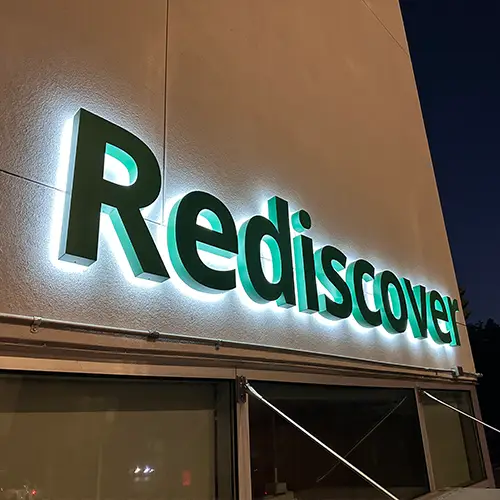
- Halo-lit (reverse-lit) letters — light spills from behind the letter onto the mounting surface, creating a glow effect. Common in premium retail and hospitality.
- Front and halo-lit combined — both effects simultaneously. High-impact and used frequently on flagship retail in West Hollywood and Santa Monica.
- Open face neon-style letters — where the LED module is visible inside an open face channel, replicating the look of traditional neon at lower operating cost.
For tenants in multi-unit plazas, channel letters are often the preferred upsell from a standard cabinet because they sit flush against the building face, feel premium, and don’t require the depth that a full cabinet enclosure demands.
The key limitation is material complexity. Channel letters require precise fabrication, careful installation to ensure consistent letter spacing and level alignment, and more detailed engineering if the building face has irregular surfaces. That’s why the quality of the backlit signs and letters fabrication process directly determines the final visual result. Poorly trimmed returns, inconsistent face depths, or off-spec acrylic colours become very obvious once the sign is lit.
Navigating LA’s Sign Permitting Requirements
Los Angeles has some of the most layered sign permitting requirements in the country. The Los Angeles Department of Building and Safety (LADBS) governs most commercial sign permits, but individual neighbourhoods, Business Improvement Districts (BIDs), and Specific Plan areas add another layer of restrictions on top.
A few things that frequently catch business owners off guard:
- Sign area calculation: LA uses specific formulas to calculate maximum allowed sign area based on building frontage. A sign that looks proportionally appropriate may still exceed the calculated limit.
- Illumination restrictions: Some districts, particularly in historic zones or residential-adjacent areas, restrict the type of illumination permitted. Flashing, animated, or high-nit LED displays may require special approval.
- Electrical permits: Any illuminated sign requires a separate electrical permit in addition to the sign permit itself. These run concurrently but involve different inspectors.
- Landlord approval: Even when a sign is code-compliant, many landlords in commercial plazas have their own Tenant Design Criteria packages that specify sign types, dimensions, and mounting methods.
Working with a sign company that handles permitting in-house is genuinely valuable here. The back-and-forth between applicant, LADBS, and occasionally the City Planning department can stretch timelines significantly without experienced navigation.
Material Choices and Long-Term Performance
The LA climate is deceptively demanding on exterior signage. While the city avoids the freeze-thaw cycles that damage signs in colder markets, UV exposure is relentless, coastal salt air affects anything within a few miles of the beach, and the Santa Ana wind events put real mechanical stress on larger sign faces.
For cabinet signs, the face material matters enormously:
- Standard white acrylic is cost-effective but tends to yellow and become brittle under sustained UV exposure within 5 to 8 years
- UV-stabilised acrylic extends lifespan significantly and is worth the upcharge on any exterior installation
- Polycarbonate faces offer superior impact resistance, useful in high-traffic areas or locations prone to vandalism
- Digital print overlays on acrylic should use UV-resistant inks and laminates; cheap prints fade within 12 to 18 months in direct sun
For channel letters, the aluminium returns and backs are generally robust, but paint choices and the quality of the trim cap (the plastic edging that connects face to return) vary. Low-quality trim cap becomes brittle and cracks. The LED modules inside should be rated for outdoor temperature ranges and include a proper IP rating for moisture resistance.
These details are typically specified during the sign manufacturing phase, which is why it’s worth asking fabricators directly about their material specs rather than assuming the default is adequate.
Placement Strategy for Maximum Impact
Even the best-fabricated sign underperforms if placement is wrong. A few principles that apply specifically to the LA market:
Contrast with surroundings first. Many storefronts in LA have beige or warm-toned facades. A white or warm-white illuminated sign face can disappear against them. Choosing a coloured face or coloured returns creates separation. Consider what the sign looks like against the building both day and night.
Account for viewing angle and distance. A sign mounted at 12 feet works differently for a pedestrian on the same block versus a driver approaching at 30mph. In auto-oriented corridors like Ventura Boulevard or La Cienega, sign height and letter sizing need to account for windshield sightlines.
Think about the dark hours specifically. Walk your location at night before finalising any sign design. What are the competing light sources? What’s the ambient brightness? A sign that reads well in daylight can be completely washed out by nearby street lighting or neighbouring tenant signs.
Consider monument signs for plazas. Multi-tenant plazas in areas like Pasadena and Burbank frequently use externally illuminated or internally lit monument signs at the street entrance to direct drivers before they even reach the building. These work alongside building-mounted illuminated signs rather than replacing them.
Key Takeaways
- Illuminated cabinet signs and backlit channel letters each suit different applications. Cabinets work well for consistent fascia systems in plazas; channel letters suit flagship storefronts where brand individuality matters.
- LED technology is the current standard for interior illumination, offering energy savings, longevity, and consistent colour output over fluorescent alternatives.
- LA’s permitting process involves multiple layers, including LADBS, neighbourhood-specific restrictions, and landlord criteria. Timelines extend quickly without experienced management.
- Material quality directly affects long-term performance. UV-stabilised acrylic, proper LED IP ratings, and quality trim cap are worth specifying at the outset rather than discovering their absence after two years of fading.
- Placement strategy, including viewing angle, contrast, and ambient competition, affects visibility as much as the sign itself.
Frequently Asked Questions
How long does it take to get a permit for an illuminated sign in Los Angeles? It varies significantly depending on location and sign type. Standard over-the-counter permits at LADBS can sometimes be processed in a few weeks, but signs in Specific Plan areas, historic districts, or locations requiring structural engineering review can take several months. Starting the permit process before the lease commencement date, rather than after, is strongly advisable.
What’s the difference between a cabinet sign and channel letters for a strip mall? Cabinet signs install into or onto a fascia as a single unit and are often specified by landlords for visual consistency across tenants. Channel letters are individually fabricated and mounted and tend to look more premium and bespoke. Many strip malls in LA permit either format, but Tenant Design Criteria packages often specify dimensional limits that apply to both.
Are there energy efficiency requirements for illuminated signs in LA? Yes. California’s Title 24 building energy code includes provisions for sign lighting. LED-based signs generally comply more easily than older fluorescent or neon systems. For larger or more complex installations, an electrician or energy consultant may need to confirm compliance as part of the permit package.
Can backlit channel letters be installed on a textured or irregular building surface? Yes, but it requires more careful installation planning. Raceway-mounted letters, where the letters attach to a single backing channel that is then mounted to the wall, are typically preferred on irregular surfaces because they allow the installer to shim the raceway level rather than contending with each letter individually. Direct-mount installations work best on flat, smooth surfaces.
How often does an illuminated cabinet sign need maintenance? In optimal conditions, a well-specified LED cabinet sign requires very little maintenance for the first several years. Most service calls are for face damage, vandalism, or wiring issues rather than LED failure. An annual visual inspection, including checking for moisture ingress and loose fasteners, is a sensible baseline. Coastal locations near Santa Monica or Marina del Rey may warrant more frequent checks due to salt exposure.
Conclusion
Illuminated signage is not a cosmetic decision, it’s an infrastructure decision. The sign on a storefront or plaza entrance is often the first branded touchpoint a customer encounters, and in a market as visually competitive as Los Angeles, the difference between a well-specified backlit sign and a mediocre one is visible from the street.
Understanding the product options, the permitting landscape, and the material considerations gives business owners and property managers the foundation to make better decisions, ask better questions, and avoid the avoidable mistakes that drive up cost and delay timelines.
The best starting point is a proper site survey, where sightlines, building dimensions, landlord criteria, and ambient conditions can all be assessed before a single design decision is made.
Los Angeles Sign Company provides full site assessments before any design work begins, evaluating sightlines, building specs, landlord criteria, and ambient lighting conditions so your illuminated sign is specified correctly the first time.
